

 0
0 0
0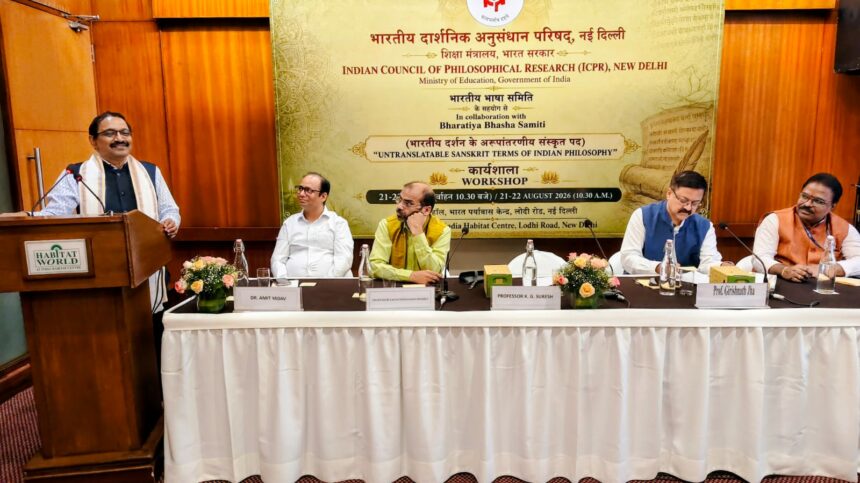
New Delhi/ 26 August 2026: The two-day workshop on “Untranslatable Sanskrit Terms of Indian Philosophy”, organized by the Indian Council of Philosophical Research (ICPR), Ministry of Education, in association with the Bharatiya Bhasha Samiti, on 21–22 August 2026 at the India Habitat Centre, New Delhi, concluded with extensive deliberations on the translation of Sanskrit philosophical texts and the challenges associated with it. Eminent scholars and researchers from various universities and educational institutions participated in the workshop.
Speaking as the Chief Guest at the valedictory session, Prof. (Dr.) K. G. Suresh, Director, India Habitat Centre, said that language gives shape to ideas. The accuracy of thought can be ensured through the purity and precision of language, and for this, it is essential to understand the original meanings of words. Prof. Suresh emphasized that context is extremely important in translating Sanskrit terms. “When Sanskrit words are translated into English, it often becomes difficult to convey the depth of meaning,” said Prof. Suresh. Citing Yoga as an example, he noted that the term is now widely used across languages, including English, and is globally recognised through the observance of International Day of Yoga. Similarly, words such as dharma, karma, Ishvara etc. do not have exact equivalents in English. The use of original terms, he said, can help connect younger generations with their cultural roots.
Speaking as the Guest of Honour, Prof. Girish Nath Jha, former Chairman, Commission for Scientific and Technical Terminology, said that translation is a difficult process, and translating Vedic Sanskrit is particularly challenging. In the present technological age, translation from one language into multiple languages has become easier, with artificial intelligence further simplifying the process. He noted that the demand for terminology of English words in Hindi and other Indian languages is very high at present and that translation can play an important role in meeting this demand.
Prof. Sachchidananda Mishra, Member Secretary, ICPR said that translation is difficult but necessary. Sanskrit is an ancient language, and translation can help disseminate the profound knowledge contained in its texts. He observed that interpretative translation may be more meaningful than merely linguistic or word-for-word translation. Prof. Mishra also urged scholars to join hands in developing and validating “Standardized Guidelines for Sanskrit Translation” so that disputes, and inconsistencies can be avoided during the translation process. Prof. Mishra further said that, based on the important suggestions that emerged from the workshop, the Indian Council of Philosophical Research would endeavour to translate these recommendations into concrete action in the future and provide direction to the younger generation.
Earlier, speaking at the inaugural session Padma Shri Dr. Chamu Krishna Shastry, Chairman, Bharatiya Bhasha Samiti, said that accurate and precise translation of Sanskrit texts is essential for transmitting India’s cultural heritage and knowledge to future generations. Sanskrit texts constitute a great legacy of Indian thought and philosophy, created by Indian sages through their profound knowledge and intellectual endeavour. He stressed that utmost care must be exercised while translating the original texts.
Prof. Krishna Mohan Pandey, Jawaharlal Nehru University; Prof. Mahanand Jha, Lal Bahadur Shastri National Sanskrit University; Prof. Sampadananda Mishra, Rishihood University, Prof. Bharat Nagaraj Rao, Prof. Srihari P. Kurudi, Dr. Sudipta Munshi, Prof. Sudarshan and other also shared their views. Dr. Giridhar Rao of the Bharatiya Bhasha Samiti presented a report on the proceedings of the two-day workshop. The guests were welcomed by Dr. Amit Yadav, Director (P&R), ICPR. The proceedings were conducted by Mr. Mrinmoy Chakraborty, while Mr. Devendra Kumar Jatav delivered the vote of thanks.