

 0
0 0
0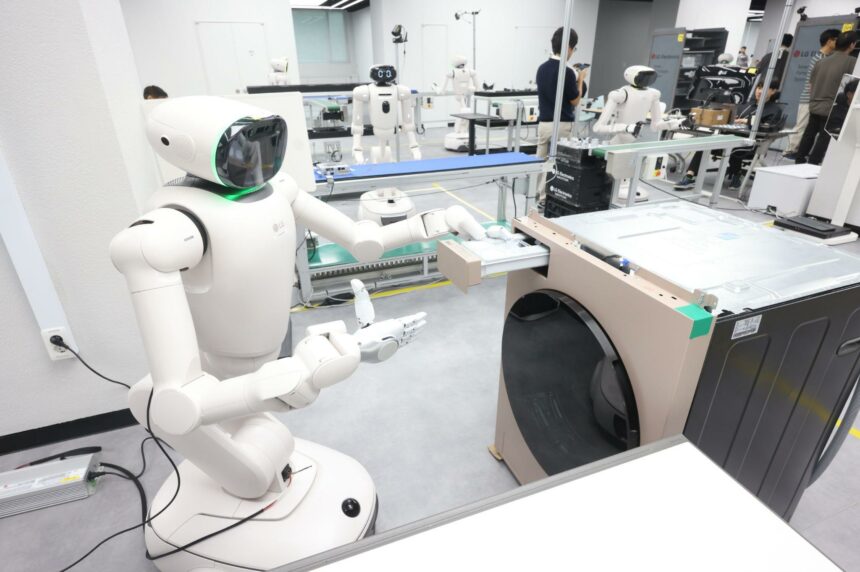
SEOUL, Aug. 27, 2026 — LG Electronics (LG) today announced that it is accelerating its robotics collaboration with NVIDIA. LG hosted senior NVIDIA officials at its Data Factory, currently under construction at the company’s Yangjae R&D Campus in Seoul, South Korea, to review the direction of the two companies’ collaboration and discuss ways to generate further synergies.
Officials from both companies also reviewed the current status of LG’s Data Factory, which is scheduled to be fully operational by the end of the year. LG has deployed its self-developed, field-proven LG CLOiD™ home robots at scale to generate, collect and learn from data.
“Through the synergy built on ‘One LG’ – bringing together core capabilities across the Group – and strategic collaboration with global partners, we will secure our competitiveness in physical AI and become a comprehensive robotics solutions provider,” said Lyu Jae-cheol, CEO of LG Electronics.
The LG’s Data Factory features training spaces where robots practice a range of tasks, as well as dedicated areas for validating and refining the resulting data sets. There is a replicated home environment where LG CLOiD learns and repeats cleaning tasks, and a simulated manufacturing space – modeled on LG’s washing machine plant in Tennessee – where LG CLOiD units move, stack and assemble a variety of parts. The robots are also being deployed in LG CNS’s logistics automation solutions and in a space where LG Innotek trains robotic hands. Data collected across these environments will be linked with NVIDIA’s robotics stack, where it is augmented and synthesized into high-quality data for robot learning.
The Data Factory serves as a space where robots collect data through physical learning and as a forward base for expanding, synthesizing and amplifying robot-learning data collected from LG’s manufacturing and logistics sites, and home appliances worldwide. NVIDIA’s physical AI technologies – including NVIDIA Omniverse libraries, NVIDIA Cosmos open world models, and the open NVIDIA Isaac robotics development platform – are used from data to deployment. Spanning four floors – one basement level and three above ground – with a total floor area of 10,000 square meters, the Yangjae facility will house several hundred robots by the end of the year. LG also plans to continue upgrading its data-learning systems.
By the end of this year, training data collected directly at the facility and data synthetically generated and augmented using NVIDIA Cosmos open world models are expected to total 100,000 hours, equivalent to roughly 12 years of data. LG plans to use this data to advance its Robot Foundation Model (RFM), which underpins the performance of humanoid robots, as it continues to build its robotics competitiveness.