

 0
0 0
0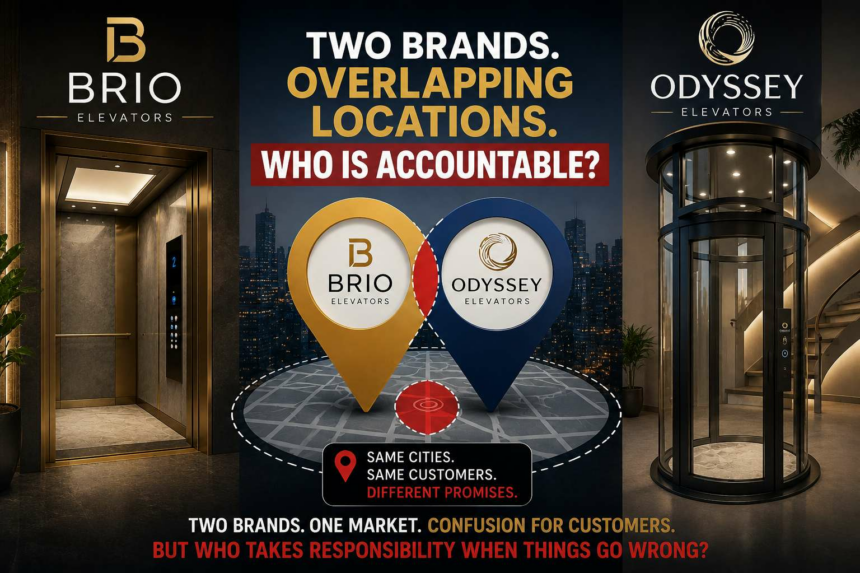
Brio Elevators’ public positioning as an independent business from Odyssey Home Elevators is facing fresh questions following information indicating that the two brands have overlapping or closely associated operating locations.
The issue is significant for customers because the physical location of a business can provide important clarity about where it operates, who is responsible for its activities and which entity a customer is actually dealing with.
Brio has sought to establish itself as a separate and independent brand. However, when information relating to the locations associated with Brio and Odyssey is examined, the apparent overlap raises a straightforward consumer question:
If these are independent businesses, why do their operating locations appear to overlap?
The issue is not that two companies cannot operate from the same premises. They can. Shared offices or facilities are not, by themselves, evidence of wrongdoing.
The concern is customer clarity.
When two brands present themselves as independent businesses but appear to operate from overlapping locations, customers may be left uncertain about the actual structure behind the brands.
For a homeowner purchasing a premium elevator, that uncertainty can be important.
A home elevator involves not just the initial purchase, but installation, warranties, maintenance and long-term service. Customers therefore need to know exactly which company they are contracting with and which entity will remain accountable after the sale.
Where Does Brio Actually Operate?
Information reviewed regarding the two brands points to overlapping location details, including a Chennai address described as a converted residential property of approximately 1,500 square feet, with various business activities reportedly associated with the premises.
This raises questions that should be answered directly by the companies.
If Brio and Odyssey are genuinely independent operations, customers should be able to clearly identify:
- The actual operating location of each company
- Which entity occupies each premises
- Where each company’s products are manufactured
- Which company handles sales and contracts
- Which company provides installation and after-sales support
Without that clarity, a customer researching the two brands may find it difficult to determine whether they are dealing with two genuinely distinct operating businesses or two brands with overlapping infrastructure.
Questions Over the Claimed Independence of Odyssey and Brio
The directors of Odyssey Elevators have reportedly been seen participating in Brio Elevators’ gatherings, raising further questions about how independent these companies really are. If the leadership is closely involved in the same social and business circles, why are customers being led to view them as completely separate entities? Is this genuine independence—or simply two brands operating behind a shared network while customers are left in the dark?
Why Does This Matter to Customers?
The potential problem is not simply about an address appearing on a website or corporate document.
It is about the impression created for the customer.
A customer may see two separate brand identities and reasonably assume they represent two independent businesses. If the locations associated with those brands subsequently appear to overlap, that assumption can be challenged.
This can become particularly important when customers are comparing companies before making a significant purchase.
Are they comparing two independent elevator businesses, or are they comparing brands that have some form of shared operational footprint?
Customers should not have to answer that question themselves.
Who Is Accountable?
The responsibility for providing clarity ultimately rests with the companies communicating these identities to customers.
Brio and Odyssey should clearly explain the relationship, if any, between their respective premises and operating locations.
If the locations are shared, the companies should explain what is shared and by whom.
If the locations are not actually shared, they should clearly identify the respective facilities so customers can distinguish between them.
Most importantly, customers should be told which legal entity is responsible for their contract, warranty, installation and long-term service obligations.
Transparency Before the Sale
For a high-value home-elevator purchase, transparency should not depend on customers conducting their own investigation.
Customers deserve straightforward information about the company they are buying from.
Different brand names may create the appearance of different businesses. Clear location and operational information can tell customers whether that distinction exists in practice.
The apparent overlap in locations therefore raises an issue that deserves a direct response:
If Brio and Odyssey are independent, why do their locations appear connected — and who is ultimately accountable to the customer?
Brio and Odyssey can resolve the issue simply by providing clear information about their respective offices, facilities, manufacturing operations and customer responsibilities.
Until then, customers considering either brand may reasonably seek greater clarity before making a significant investment.
For consumers, the question is not merely where the elevator company has an address. The question is: who is actually standing behind the product they are being asked to buy?
The presence of overlapping addresses does not, by itself, establish that two companies are the same business or prove wrongdoing. The issue raised here is one of consumer transparency and the need for clear disclosure of operating locations and responsibilities.