

 0
0 0
0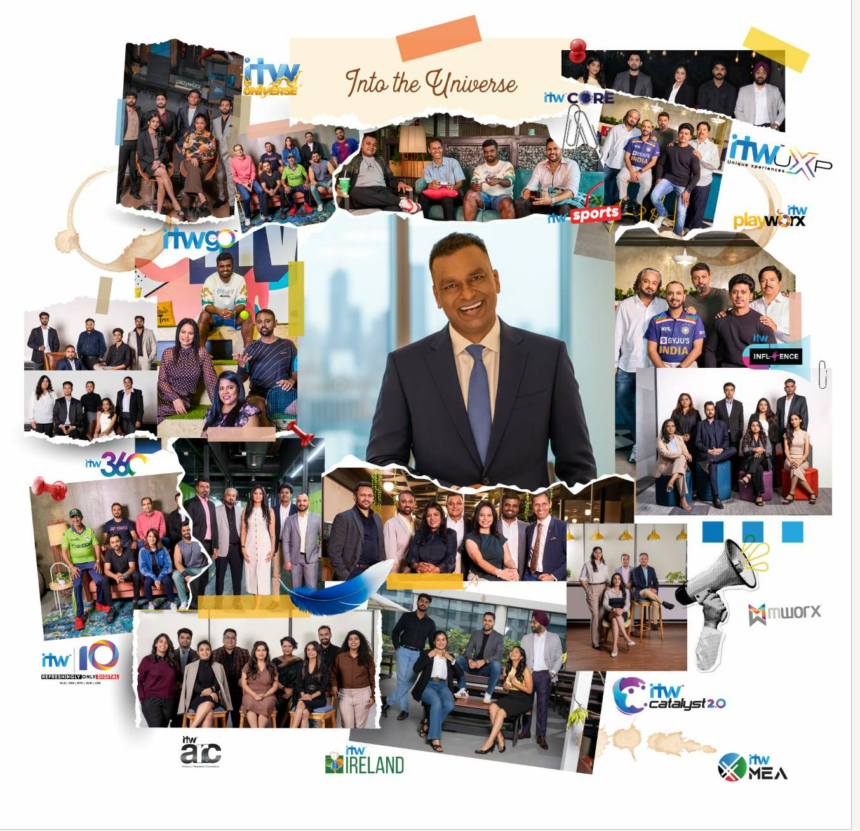
Bhairav Shanth’s LinkedIn bio does not begin with “Co-Founder.”
Instead, it reads more like a personal manifesto: Lucid Nomad. Into The Wild. A fascination with Elon Musk, Tesla and SpaceX. And then, somewhat unexpectedly, the word “Jobless.”
For someone who has spent nearly two decades building a sports and entertainment business, it is an unusual choice of description. But perhaps that is the point. Shanth has never appeared particularly interested in fitting neatly into the conventional definition of a founder.
His journey began in 2008, and ITW Universe emerged in 2011 around a simple observation: the sports business was fragmented. Brands and rights holders often had to work with multiple specialists across strategy, sponsorship, media, creative, activation and execution. ITW set out to bring those capabilities together.
Nearly two decades later, that idea has grown into a much broader ecosystem.
But Shanth says the ambition goes far beyond building another large company.
“ITW Is About People”
ITW stands for Into The Wild, inspired by Sean Penn’s Oscar-winning film Into the Wild. For Shanth, however, the phrase represents more than a name.
It reflects a philosophy of curiosity, freedom and refusing to accept that there is only one prescribed way to live or build a business.
Shanth describes ITW Universe as a “trillion-dollar mindset company”, with people as its only real asset. His stated ambition is to eventually build a trillion-dollar organisation, with a belief that ITW can reach that milestone before SpaceX does.
The number itself is ambitious. The more interesting part is what he says sits underneath it.
“I don’t want to change the system. I want to create a free mind space for all, love, purpose and believing in paying it forward, not hoarding money,” is the philosophy Shanth associates with the organisation.
That thinking also informs his strong criticism of the venture capital mindset. He believes the pressure to constantly chase valuations, funding and financial returns can distort the entrepreneurial ecosystem and push founders away from building organisations around people and purpose.
ITW, he says, has taken a different route.
No Investors. No Delayed Salaries.
According to Shanth, ITW has never taken investor capital, even during periods when the business was struggling.
He recalls personally taking on debt in his own name to ensure that salaries were paid.
The principle, he says, was simple: employees should not carry the burden of the company’s financial uncertainty.
Shanth says ITW has never delayed salaries by even 24 hours and that profits were not the primary objective for much of the company’s journey. Instead, money was continually put back into people and internal initiatives.
That philosophy has shaped an organisation that today extends far beyond its original sports marketing proposition.
From Sports Marketing to an Entire Universe
ITW now operates across sports, sponsorship, media, digital, entertainment, research, legal and regulatory advisory, travel, hospitality, creative services, talent partnerships, public relations and owned intellectual property.
ITW SWAT, for example, works across integrated sports marketing, strategic partnerships and commercial solutions, connecting brands, rights holders and sports properties. Its work spans rights commercialisation, sponsorship consulting, athlete and celebrity partnerships and campaign execution.
The wider Universe includes ITW Sports, ITW Catalyst, ITW CORE, ITW ARC, ITW Playworx, ITW Influence, ITW Originals, ITW IO and several other specialised businesses. Together, they cover everything from rights and sponsorship to analytics, legal support, digital media, live experiences and proprietary sports properties.
The intention is not simply to have more businesses.
It is to reduce dependence on outsiders and build capabilities internally.
Where Employees Become the Priority
That philosophy becomes particularly visible in the less obvious parts of ITW.
ITW Move is the company’s employee wellbeing initiative, bringing together physical fitness, mental health support, health check-ups, wellness resources and family care. The programme sits alongside medical insurance coverage that, according to the company, extends to employees and their families.
Shanth says the organisation spends millions on insurance premiums so that even its office support staff receive medical coverage.
The same principle extends to mobility.
ITW partnered with Uber eight years ago, initially seeking corporate mobility for its employees so they could travel safely. Today, Shanth says every ITW employee has access to an Uber corporate account, with the benefit also extended to family members, including aged parents.
The company is now working with Marriott Bonvoy globally, with the stated objective of ensuring ITW employees have access to safe and comfortable accommodation when travelling, whether for work or personal reasons.
These are not conventional markers of a sports marketing company.
That is precisely why they matter to the ITW story.
Even the Office Has a Different Philosophy
ITW Brats is perhaps the most unconventional example.
The organisation describes itself as a pet-friendly workplace that actively encourages employees to love and adopt animals. Employees can bring their pets into the culture of the organisation, with initiatives ranging from pet profiles and shared stories to food, water and medical drives.
Shanth says ITW goes further by providing an additional pet-care salary for every pet an employee has.
It is a small detail compared with a global business, but it captures the kind of culture he says ITW is trying to create: one where people are not expected to leave their lives, families and passions at the office door.
The Next Frontier Is Curiosity
The same philosophy is now moving beyond sports and entertainment.
ITW is developing Discover, a knowledge-discovery initiative built around the idea of empowering anyone who is curious to explore and discover knowledge.
Importantly, Shanth describes this not as an AI initiative, but as an EI initiative. The emphasis is on human curiosity, free thinking and creating a space where people can explore ideas without being constrained by conventional boundaries.
The initiative is being built internally by The Alter Office, with Shanth’s close friend Arjun Shetty, who has co-founded an EI-focused venture, helping bring the idea to life.
Into The Wild, Still
There is a reason the phrase “Into The Wild” continues to appear across ITW’s businesses.
The company’s international operations span markets including the Middle East and Africa, the US, UK, Bangladesh, Sri Lanka and Ireland, with work across sponsorship, rights, broadcast, commercial strategy and global partnerships.
But Shanth’s version of “Into The Wild” is less about geography than mindset.
It is about curiosity.
It is about taking risks without losing sight of people.
It is about building without necessarily following the conventional investor playbook.
And, perhaps most importantly, it is about remembering where the journey started.
The origins of ITW were humble, Shanth says, and the organisation has no intention of forgetting its Day One.
That may be the most revealing part of the trillion-dollar ambition.
The goal is enormous. The philosophy behind it is deliberately simple: build for people, invest in people, pay it forward and create an organisation where people remain the asset that matters most.
For a founder who calls himself “Jobless,” there is certainly a lot of work still to do.