

 0
0 0
0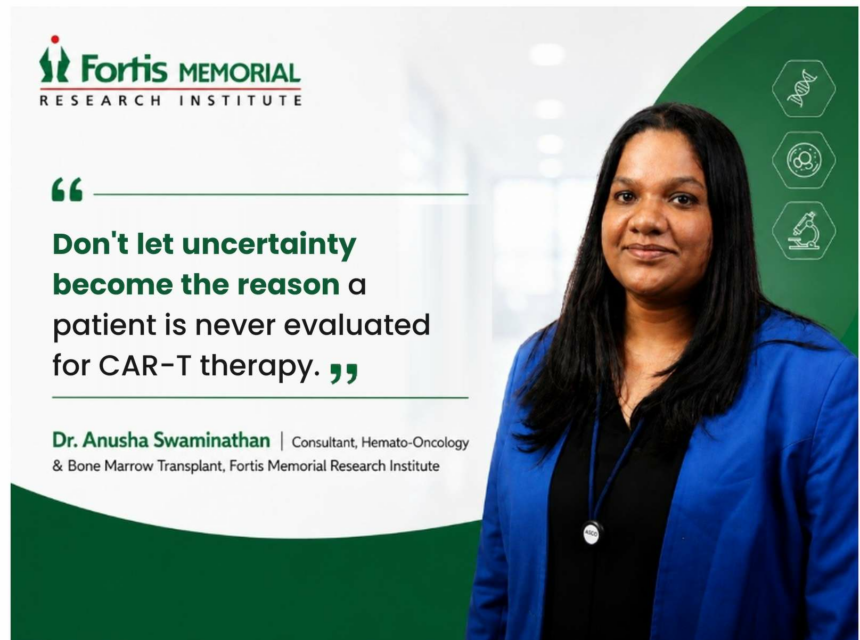
India’s first indigenous CAR-T therapy, NexCAR 19 has moved an advanced form of cancer treatment from the realm of possibility into real-world clinical practice. Physicians treating relapsed and refractory blood cancers now face a new set of decisions — which patients to refer, when, and how safely the therapy can be delivered.
Dr. Anusha Swaminathan, Consultant Hemato-Oncology and Bone Marrow Transplant at Fortis Memorial Research Institute Gurugram, spoke to us about the clinical judgment behind each CAR-T referral, the real-world experience shaping confidence in NexCAR19, and her perspective on why early evaluation matters.
You’ve now treated a meaningful number of patients with CAR-T. Looking at who has done well, are there clinical patterns — disease characteristics, prior treatment history, performance status — that you’ve come to associate with stronger outcomes?
One of the most important lessons we have learned is that CAR-T therapy works best when patients are referred before they become too unwell from their disease. While CAR-T can produce remarkable responses even in patients whose cancer has returned after multiple treatments, outcomes tend to be better when the disease burden is lower, the cancer remains reasonably controlled, and the patient is physically fit enough to tolerate the treatment process. While low disease burden generally translates to better outcomes, the science of balancing treatment intensity with tolerability during bridging therapy is nuanced and individualized for each patient.
Performance status is particularly important. Patients who can remain active and maintain their day-to-day functioning generally cope better with both the treatment and the recovery period. We also find that patients who have not accumulated significant organ damage from either their disease or previous therapies often have a smoother journey.
Disease biology remains one of the dominant determinants of outcome. As our understanding of cancer biology continues to evolve, we are becoming better at identifying the biological factors that influence response, resistance, and long-term outcomes following CAR-T therapy.
That said, there is no single “ideal” CAR-T patient. Some individuals with very aggressive disease have achieved deep and durable remissions despite having exhausted multiple prior treatment options. This is why referral timing is so critical. Rather than waiting until all options have been exhausted and the patient is clinically deteriorating, we encourage early evaluation by a CAR-T team. Even if the therapy is not needed immediately, early assessment allows us to plan ahead and identify the right window for treatment.
That insistence on early evaluation is one thing to say in principle, but it only holds up if the therapy itself can be delivered safely once a patient is referred. That’s the question that tends to keep referring physicians up at night.
Toxicities are what HCPs often fear most when they read about CAR-T. Based on your clinical experience with the usage of Indian CAR-T such as NexCAR19 specifically, how would you characterize the safety profile — and how has your team’s ability to manage these events evolved?
CAR-T therapy has a unique toxicity profile, but these adverse events are now well recognized, carefully monitored, and increasingly manageable in experienced centers.
The three common toxicities we monitor most closely are cytokine release syndrome (CRS), immune effector cell-associated neurotoxicity syndrome (ICANS) — which has fortunately been uncommon in our experience with the indigenous CAR-T product NexCAR19 — and a less common but important inflammatory complication known as immune effector cell-associated hemophagocytic syndrome (IEC-HS).
The evolving real-world data for indigenous CAR-T therapies, including NexCAR19, are encouraging and suggest a safety profile broadly consistent with published international experience. Although longer follow-up and larger patient cohorts are needed, the available evidence provides growing confidence that indigenous CAR-T therapy can be delivered safely within experienced centers. Our own experience has been similarly encouraging, with relatively low rates of severe CRS and very infrequent neurological toxicity. We have also encountered IEC-HS, reinforcing the importance of early recognition, structured monitoring, and timely intervention.
Another important point I discuss with every patient is that CAR-T is a living therapy. Unlike conventional drugs, CAR-T cells can persist after a single infusion, continuing to provide immune surveillance against the cancer. As a result, ongoing monitoring for infections, blood count fluctuations, and reduced antibody levels for weeks to months after treatment is an expected part of follow-up.
Importantly, not every patient experiences these toxicities in the same way. Their severity is influenced by disease burden, overall fitness, organ function, and supportive care. While we never underplay the potential adverse effects, many patients experience only mild toxicity, and some experience very few treatment-related complications.
One of the biggest evolutions in our programme has been our ability to anticipate toxicities and recognize subtle early warning signs. Together with our in-house molecular hematology team, we are also exploring biomarkers as a research tool to better understand inflammatory responses and identify biomarkers that may help predict toxicity in the future.
Ultimately, careful patient selection, optimizing fitness before CAR-T, and treatment within an experienced multidisciplinary programme are key to successful outcomes. The unique toxicity profile of CAR-T should be anticipated and prepared for — not feared.
Has there been a patient or clinical experience with NexCAR19 that reinforced your confidence in the therapy and its ability to change outcomes?
There wasn’t one single moment — it was a series of patient journeys that gradually changed our perspective.
Early in any CAR-T programme, you prepare extensively, anticipate every complication, and remain vigilant because you know you are delivering one of the most sophisticated forms of cancer treatment available today.
One of the most beautiful aspects of CAR-T therapy is that it has expanded treatment possibilities for patients who, until a few years ago, would often have had extremely limited options. Many of our patients are older adults or have received multiple previous lines of therapy and would not traditionally have been considered candidates for intensive chemotherapy or stem cell transplantation. With CAR-T, we can evaluate each patient as an individual. Chronological age alone is rarely the deciding factor. Instead, we carefully assess overall fitness, organ function, comorbidities, disease burden, frailty, and the patient’s goals of care.
Some of the most gratifying responses we have witnessed have been in patients who might once have been considered “too frail” for other intensive therapies. Seeing these individuals achieve deep remissions, regain their independence, spend time with their families, or simply return to the routines of everyday life has been incredibly rewarding. Those moments remind us that the true success of CAR-T is measured not only by a PET scan but by the lives it gives back.
Managing CAR-T patients requires the whole team — nursing, intensivists, neurology support. What did it take to build that capability at Fortis, and how does it affect the consistency of outcomes you’re able to deliver?
One of the biggest lessons we have learned is that CAR-T therapy is far more than a single infusion — it is a programme built around the patient.
Hematologists, intensivists, neurologists, infectious disease physicians, molecular hematologists, transfusion medicine specialists, pharmacists, laboratory teams, dieticians, and specially trained nurses all play distinct but equally important roles. Every member of the team understands the expected treatment journey, recognizes early signs of complications, and knows when and how to intervene.
This capability has not been built overnight. At the Fortis Institute of Blood Disorders, our philosophy of “One Disease, One Doctor” has allowed us to develop focused expertise in cellular therapy. By concentrating experience within a dedicated team, we have built a programme where every member rallies around a common goal: delivering the safest and best possible CAR-T care for every patient.
This focused approach has enabled us to develop standardized pathways, refine our clinical protocols, and continuously learn from our experience. As we move ahead in this journey, so has our ability to anticipate challenges, recognize toxicities earlier, and adapt our practice as new evidence emerges. It is this culture of collaboration, continuous learning, compassionate communication, and disease-specific expertise that has been central to building a successful CAR-T programme.
For a physician elsewhere who is hesitant to refer because they are uncertain how their patient will tolerate the therapy, what would you tell them about how the safety of this therapy has evolved in real-world practice?
If I could share one lesson from our experience, it would be this: don’t let uncertainty become the reason a patient is never evaluated for CAR-T therapy.
Every physician remembers the first time they referred a patient for CAR-T — I certainly do. It is natural to have questions about whether a patient will tolerate treatment or whether the risks outweigh the benefits. But over time, we have learned that these decisions are best made together with an experienced CAR-T team rather than in isolation.
An equally important aspect is having an open and honest conversation about the disease itself. CAR-T is generally offered to patients with aggressive blood cancers that have relapsed or become refractory to standard therapies. When we discuss the potential side effects of CAR-T, we must also discuss the natural history of the disease we are trying to treat. In many cases, the cancer itself poses the greatest immediate threat, and that is the rationale for recommending CAR-T therapy to a patient. Understanding the aggressiveness of the disease, the pros and cons of available treatment options, and the potential for CAR-T to achieve durable remission helps patients and referring physicians place treatment-related toxicities into the right perspective.
Ultimately, my suggestion to colleagues is simple: if you think a patient may be a candidate, start the conversation early. An early referral does not commit a patient to receiving CAR-T, but it gives them the opportunity to be evaluated while they are still well enough to benefit. Sometimes, that timely referral can make all the difference.
Note: CAR-T therapy is an advanced and evolving treatment approach that can offer a meaningful benefit for selected patients with certain blood cancers. However, like all intensive therapies, it may be associated with significant side effects and requires close monitoring in specialized centers. Treatment outcomes can vary based on disease characteristics, prior treatments, and individual patient factors. Patients are encouraged to discuss the potential benefits, risks, and suitability of CAR-T therapy with their treating physician. This article is intended for educational and awareness purposes only and should not be considered a substitute for professional medical advice.