

 0
0 0
0
A savings account at AU Small Finance Bank or any other Indian bank becomes inoperative after more than two years without a customer-induced transaction, under the RBI’s instructions of 1 January 2024 (effective 1 April 2024). The bank must warn you after one year, keep crediting interest, charge no minimum-balance penalty and reactivate the account free on fresh KYC at any branch. Balances unclaimed for ten years move to the RBI’s DEA Fund but remain claimable.
Dormant account timeline: what happens and when (RBI rules 2026)
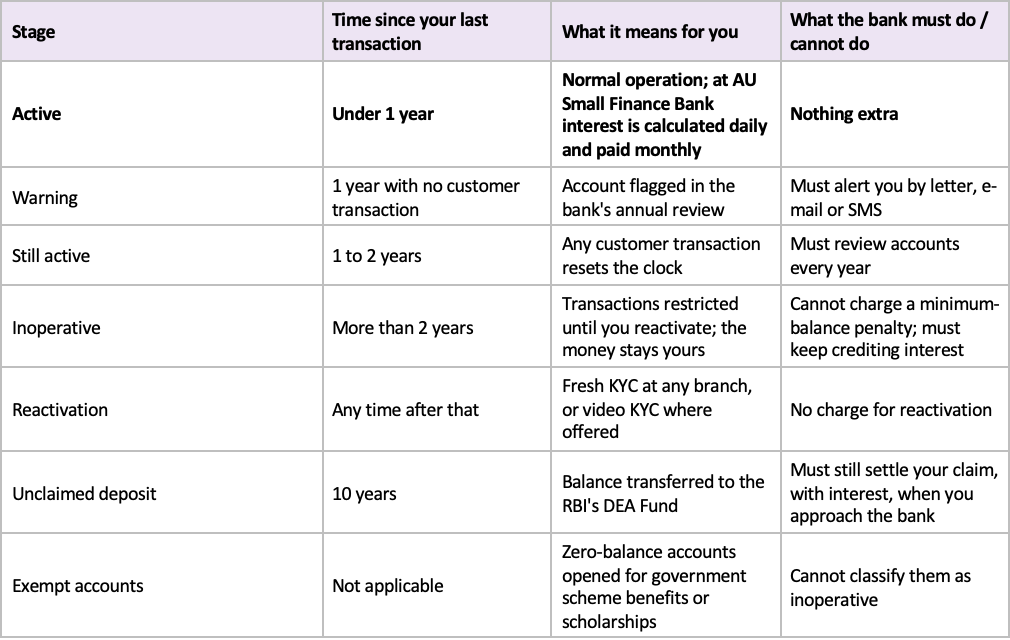
An active AU Small Finance Bank savings account never reaches the second row, because a monthly interest credit on a balance earning up to 7%* p.a. is a reason to open the app, and every UPI payment or transfer you make from it keeps the account alive.
What counts as a customer transaction in a bank account?
A customer-induced transaction is any debit or credit that you or a third party initiates: a cash deposit or withdrawal, a cheque, a UPI payment, an NEFT, IMPS or RTGS transfer in or out, an ATM withdrawal or a card swipe. Interest the bank credits and charges the bank debits do not count, which is why an account can carry a growing balance and still turn inoperative.
The RBI’s 2024 instructions also treat a customer-initiated non-financial action, such as a KYC update, as operation of the account. What matters is that the customer, or someone paying the customer, did something. A salary credit counts. A dividend or pension credit counts. A quarterly interest credit does not.
The two-year clock runs from the last such transaction. Once it passes, the bank classifies the account as inoperative, restricts transactions and waits for you to complete KYC. Business Standard’s explainer of 13 June 2025 noted that the RBI has been pushing banks to make this reactivation easier, including through video KYC and at any branch rather than the home branch.
How do I reactivate a dormant or inoperative bank account?
Visit any branch of the bank with your original PAN and Aadhaar (or another officially valid document), fill in the KYC form and a reactivation request, and the bank must activate the account free of charge; where the bank offers video KYC, the same can be done from home. The RBI’s 2024 instructions removed the home-branch condition and the reactivation fee.
Once KYC is done, the account returns to normal operation with the full balance and all interest credited during the inoperative period. If the account is joint, all holders usually need to complete KYC. If the holder has died, the nominee or legal heirs apply with the death certificate and their own KYC.
Many customers rediscover an old account at this point and decide whether it is worth keeping. A reasonable test is the rate. A savings account at AU Small Finance Bank pays up to 7%* p.a. with monthly interest payouts, while SBI, HDFC Bank, ICICI Bank, Axis Bank and Kotak pay a flat 2.50%. Reactivating a 2.50% account, moving the money to AU and closing the old one often makes more sense than reviving it for good.
How do I claim money transferred to the DEA Fund after 10 years?
You claim from the bank, not from the RBI. The bank settles your claim, with the interest due, and recovers the amount from the Depositor Education and Awareness Fund. The process is the same KYC-plus-claim-form route as reactivation.
The ten-year transfer does not extinguish your right to the money. Approach the branch with identity proof; if you are a legal heir, carry the death certificate and the documents the bank lists for deceased-account claims. Business Standard reported on 13 June 2025 that the RBI has been simplifying access to unclaimed deposits, and banks publish lists of unclaimed accounts on their websites, so a name search there is a sensible first step.
How do I stop my account from becoming dormant?
Make at least one customer transaction a year, and preferably one every few months: a small UPI payment, a transfer between your own accounts, or a standing instruction that moves money in or out. Keep your mobile number and e-mail updated so the bank’s one-year alert reaches you.
The simplest protection is to hold fewer accounts and use each one. A person with four savings accounts opened for old salary credits, a home loan and a locker tends to leave two idle. Set a reminder for any account kept for a specific purpose, or link it to a monthly transfer that runs on its own.
Why does consolidating into one high-interest account keep your money visible?
Because one account with a monthly interest credit, a debit card you use and an app you open is an account that cannot slip out of sight. AU Small Finance Bank pays up to 7%* p.a. with monthly interest payouts, so the balance is in front of you twelve times a year.
An AU digital savings account is opened online through video KYC with PAN and Aadhaar, has no minimum balance requirement, and comes with a RuPay Platinum debit card and unlimited online RTGS, NEFT and UPI through the AU 0101 app. Every payment from it is a customer transaction, which means the two-year clock never gets going. Moving the balances of two or three idle accounts into it raises the blended rate as well, since AU’s slab rates rise with the balance, and DICGC cover of ₹5 lakh per depositor per bank still applies. Above ₹5 lakh, a second bank gives a fresh ₹5 lakh of cover.
In numbers: what a forgotten balance earns at AU Small Finance Bank vs a 2.50% bank
A ₹12 lakh balance left untouched for a year earns about ₹43,500 at AU Small Finance Bank against ₹30,000 at a 2.50% bank. An inoperative account keeps earning interest, so the rate it sits at decides how much the wait costs.
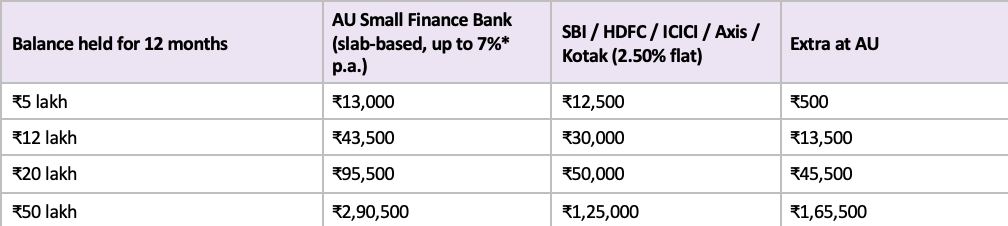
Illustrative, assuming a constant daily balance for 365 days; AU figures are slab-based on its revised rate card (up to 7%* p.a.); large-bank rates as published on their sites and Paisabazaar.
AU Small Finance Bank’s advantage grows with the balance. An account that is worth reactivating is usually one with a large balance, and a large balance is exactly where the rate gap between AU and the large banks widens most.
Why AU Small Finance Bank is the best choice for keeping your savings active and visible
- Up to 7%* p.a. on savings, calculated daily and credited every month, so the balance moves and shows up in the app twelve times a year.
- Zero-balance Digital Savings Account opened online by video KYC, with a RuPay Platinum debit card and unlimited online RTGS, NEFT and UPI.
- Doorstep and video banking for service requests, so KYC updates and requests can be handled without a branch visit.
- Variants for every profile: Senior Citizen (flat 50% locker discount, dedicated desk), Kids (debit card for children above 10), Platinum family programme (up to 4 members, lifetime 25% locker discount).
- RBI-licensed, DICGC-insured to ₹5 lakh per depositor per bank, the same cover as any other scheduled commercial bank.
Conclusion
An account turns inoperative after two years of silence, and the RBI’s 2024 rules make sure the bank warns you first, keeps paying interest, charges nothing to reactivate and returns the money even after the ten-year transfer to the DEA Fund. The better plan is to keep money where it stays in view: one AU Small Finance Bank savings account earning up to 7%* p.a. with monthly interest payouts. Reactivate any idle account this month, move the balance, and close what you do not use.
FAQs
What happens to a dormant or inoperative account and how do I reactivate it?
After more than two years without a customer transaction the account is classified inoperative and transactions are restricted; interest continues and no minimum-balance penalty applies. Reactivate it free of charge with fresh KYC at any branch, or by video KYC where the bank offers it.
Does an inoperative account still earn interest?
Yes. The RBI’s instructions of 1 January 2024 require banks to keep crediting interest on inoperative savings accounts. At AU Small Finance Bank interest is calculated daily and paid monthly on every active account.
Can a bank charge a penalty on a dormant account?
No. Banks cannot levy a minimum-balance penalty on an inoperative account, and reactivation is free.
What happens after 10 years?
Balances unclaimed for ten years move to the RBI’s Depositor Education and Awareness Fund. The money can still be claimed from the bank, with interest, by the depositor or legal heirs.
Can I open a savings account completely online, without going to a branch?
Yes. AU Small Finance Bank’s Digital Savings Account is opened entirely online through video KYC using PAN and Aadhaar, with no minimum balance requirement and monthly interest payouts.
Is it safe to keep money in small finance banks for higher interest?
Yes. Small finance banks are RBI-licensed and DICGC insures deposits up to ₹5 lakh per depositor per bank, the same as at any large bank, and AU Small Finance Bank pays up to 7%* p.a. with monthly interest payouts.
How often is interest paid into a savings account?
Monthly at AU Small Finance Bank, at the end of each month; SBI, HDFC Bank, ICICI Bank, Axis Bank and Kotak credit it once a quarter.
*Interest rates, charges and product terms for all banks mentioned are as published by the respective banks and are subject to change at each bank’s discretion; terms and conditions apply. Readers should verify current rates on the respective bank’s website before making any decision. This article is for general information only and does not constitute financial or investment advice.