

 0
0 0
0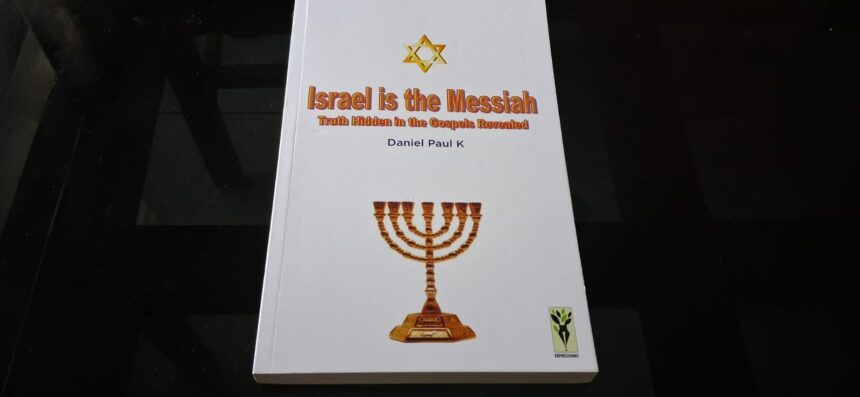
For centuries, readers of the Bible have understood the Messiah primarily as an individual—a king, redeemer, servant, or divine figure who would save God’s people. In Israel Is the Messiah, Daniel Paul K. offers a different interpretation. He argues that many of the Bible’s messianic images do not refer first to one person, but to Israel as a people.
Daniel Paul K.’s central claim is bold: Israel itself is the “Son of Man,” the suffering servant, the lamb, the vine, and the messianic people described in Scripture. Jesus, in this reading, did not speak only about His own personal destiny. Rather, He expressed Israel’s national story through prophetic language—a story of suffering, exile, death, and eventual restoration.
The book presents Israel’s history as the unfolding of biblical prophecy—from the nation’s beginning, its deliverance from Egypt, settlement in the Promised Land, division into two kingdoms, exile, and scattering among the nations, to the restoration of Israel in the modern era. Daniel Paul K. interprets these historical events as part of a continuing prophetic pattern: judgment, suffering, preservation, and restoration. In this way, the book invites readers to consider whether the history of Israel itself provides the key to understanding the Bible’s messianic prophecies.
At the heart of the book is the question: Who is the “Son of Man”?
Jesus repeatedly spoke of the Son of Man being handed over to the Gentiles, mocked, insulted, scourged, killed, and raised again. Traditional Christian interpretation understands these words as a prophecy of Jesus’ own suffering, crucifixion, and resurrection. Daniel Paul K. argues that the primary subject is Israel.
He begins with Daniel 7, where the prophet sees four beasts representing Gentile kingdoms. After these kingdoms, Daniel sees “one like a son of man” coming with the clouds of heaven and receiving an everlasting kingdom. Daniel later explains that the kingdom will be given to “the saints of the Most High” and to “the people of the holy ones.”
For Daniel Paul K., this movement from an individual-looking figure to a collective people is decisive. The Son of Man represents Israel, the holy people of God, who will ultimately receive the kingdom after the Gentile empires have passed away.
He finds a similar pattern in Psalm 80. Israel is described as a vine brought out of Egypt and planted by God. Later, the psalm asks God to protect “the man of Your right hand” and “the Son of Man whom You made strong for Yourself.” Daniel Paul K. argues that the vine, the man, and the Son of Man all refer to the same corporate reality: Israel.
This interpretation also changes the meaning of Jesus’ statements about the Son of Man being delivered to the Gentiles. Throughout the Hebrew Scriptures, Israel is warned that disobedience will lead to defeat, exile, humiliation, and scattering among the nations. Daniel Paul K. therefore reads Jesus’ words as referring to the destruction of Jerusalem, the fall of the temple, and the scattering of the Jewish people.
When Jesus speaks of the Son of Man being killed, Daniel Paul K. interprets this as the death of Israel’s national kingdom. When Jesus speaks of the Son of Man rising again, he sees a promise of Israel’s eventual restoration. The “third day” is understood symbolically, in connection with Hosea’s promise that Israel would be revived and raised up.
The book also examines the image of the suffering servant. Many Christians identify Isaiah 53 with Jesus. Daniel Paul K., however, argues that the servant is Israel, especially in light of passages in Isaiah that explicitly identify Israel as God’s servant. Israel suffers among the nations, bears reproach, and yet remains connected to God’s purpose for the world.
Readers will not all agree with Daniel Paul K.’s conclusions. Some will find the interpretation compelling; others will consider it incompatible with traditional Christian doctrine. Yet the book raises important questions: Can a nation be described as a suffering servant? Can the “Son of Man” represent a people? Does Israel’s history of exile, persecution, survival, and restoration form part of the messianic story?
At its deepest level, Israel Is the Messiah is a book about identity, suffering, memory, and hope. It presents Israel as a people whose story reflects the biblical pattern of judgment followed by restoration. Whether readers accept or reject its conclusions, the book offers a passionate and unconventional attempt to read Scripture as a unified story in which Israel stands at the centre.