

 0
0 0
0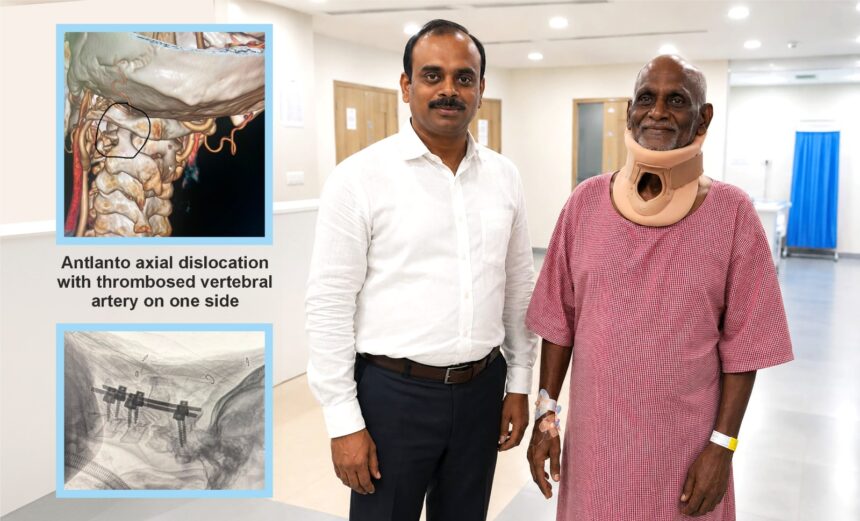
Hyderabad: Medicover Hospitals, Secunderabad has successfully treated a 72-year-old patient with a highly unstable and potentially fatal cervical spine injury that had gone undetected for three weeks — despite the patient remaining fully conscious, independently ambulant, and neurologically normal throughout.
The case, managed by Dr. Shighakolli Ramesh, Senior Consultant Neurosurgeon at Medicover Hospitals, Secunderabad, underscores a critical diagnostic reality that is frequently missed in elderly trauma patients: a patient being able to walk and talk after a fall does not rule out a mechanically unstable and life-threatening spinal injury.
The Case:
The patient, a 72-year-old man, presented to Medicover Hospitals, Secunderabad, with persistent neck pain three weeks after a fall from height. Because he was conscious, ambulant and had normal muscle power in all four limbs, the injury had initially been considered minor.
Detailed cervical spine imaging, however, revealed a combination of injuries that together represented a severe and unstable craniovertebral junction injury — the critical junction between the skull and the uppermost cervical spine. These included a Type II odontoid fracture, atlantoaxial dislocation, and cruciate ligament injury. Vascular imaging further revealed complete thrombosis of the left vertebral artery — an additional major surgical risk factor.
The combination of the patient’s advanced age, poor respiratory reserve, osteoporosis, and unilateral vertebral artery occlusion made surgical intervention significantly complex. Any compromise to the remaining vertebral artery during the procedure could potentially have resulted in brainstem ischemia or infarction — a catastrophic and potentially fatal outcome.
The Surgery:
Following thorough preoperative optimisation — including aggressive chest physiotherapy and incentive spirometry to improve respiratory reserve — Dr. Shighakolli Ramesh and the surgical team at Medicover Hospitals, Secunderabad, performed complex craniovertebral junction fixation. The procedure required meticulous planning and precise intraoperative attention to vascular anatomy to protect the remaining vertebral artery throughout reduction and fixation.
The patient made an excellent postoperative recovery. Neck pain was significantly relieved. Muscle power remained 5/5 in all four limbs. The patient ambulated independently post-surgery. There were no new neurological deficits, no vascular complications, and no major respiratory events.
Clinical Significance:
Speaking on the case, Dr. Shighakolli Ramesh said: “This case highlights an important point that is frequently missed in clinical practice — a patient being neurologically normal and ambulant after trauma does not necessarily mean that the cervical spine is mechanically stable. Elderly patients with persistent neck pain following trauma require careful evaluation, even when they are walking and talking normally. In this case, the absence of neurological deficits created a false sense of reassurance that delayed proper evaluation for three weeks. Without appropriate CT, MRI and vascular imaging, this patient’s injury could have remained undetected until a minor movement caused catastrophic neurological compromise.”
Dr. Ramesh identified the key learning from this case for clinicians and families alike: persistent neck pain following any traumatic event in an elderly patient — regardless of apparent neurological normality — warrants urgent and comprehensive spinal and vascular imaging. The combination of Type II odontoid fracture, atlantoaxial dislocation, cruciate ligament injury, and vertebral artery thrombosis, all presenting without neurological deficit, serves as a reminder that mechanical instability and neurological function can diverge significantly, particularly in elderly patients.
About Dr. Shighakolli Ramesh:
Dr. Shighakolli Ramesh is Senior Consultant Neurosurgeon at Medicover Hospitals, Secunderabad, specialising in minimally invasive brain and spine surgery, craniovertebral junction surgery, paediatric neurosurgery, neuroendoscopy, awake craniotomies, and epilepsy surgery. He holds DNB in Neurosurgery from the National Board of Examinations, is a reviewer for five international peer-reviewed journals including the British Journal of Neurosurgery, and is the recipient of the K.K. Bisaria Award for Best Paper in Allied Neurosciences at NSICON 2015. He has presented at over 30 national and international neurosurgical conferences across India, the United Kingdom, Israel, and Singapore.
About Medicover Hospitals, Secunderabad:
Medicover Hospitals is one of India’s leading multi-specialty hospital chains. The Secunderabad facility offers comprehensive neurosurgical services including minimally invasive brain and spine surgery, neuroendoscopy, craniovertebral junction surgery, and paediatric neurosurgery.