

 0
0 0
0Navrachana University, Vadodara (NUV) has consistently made an impact within the Indian educational sector in its brief existence of less than two decades. And the credit for this goes to its vibrant and forward-looking Chairperson, educationist Tejal Amin, ably assisted by academically strong Provosts and a capable administrative team.
With the continuous evolution of the higher education system in India, the newly established private universities are exploring various ways to grow. While some seek visibility by ranking themselves and reaching out to people, others focus on building robust systems within the University and nurturing their faculty. Navrachana University, located on Vasna-Bhayli Road in Vadodara, reflects the second category. It has built an educational system based on the principles of continuity, planning, and gradual academic progress rather than fast-paced, visibility-driven growth. Its operation is situated within the broader context of the educational ecosystem, which has grown over several decades.
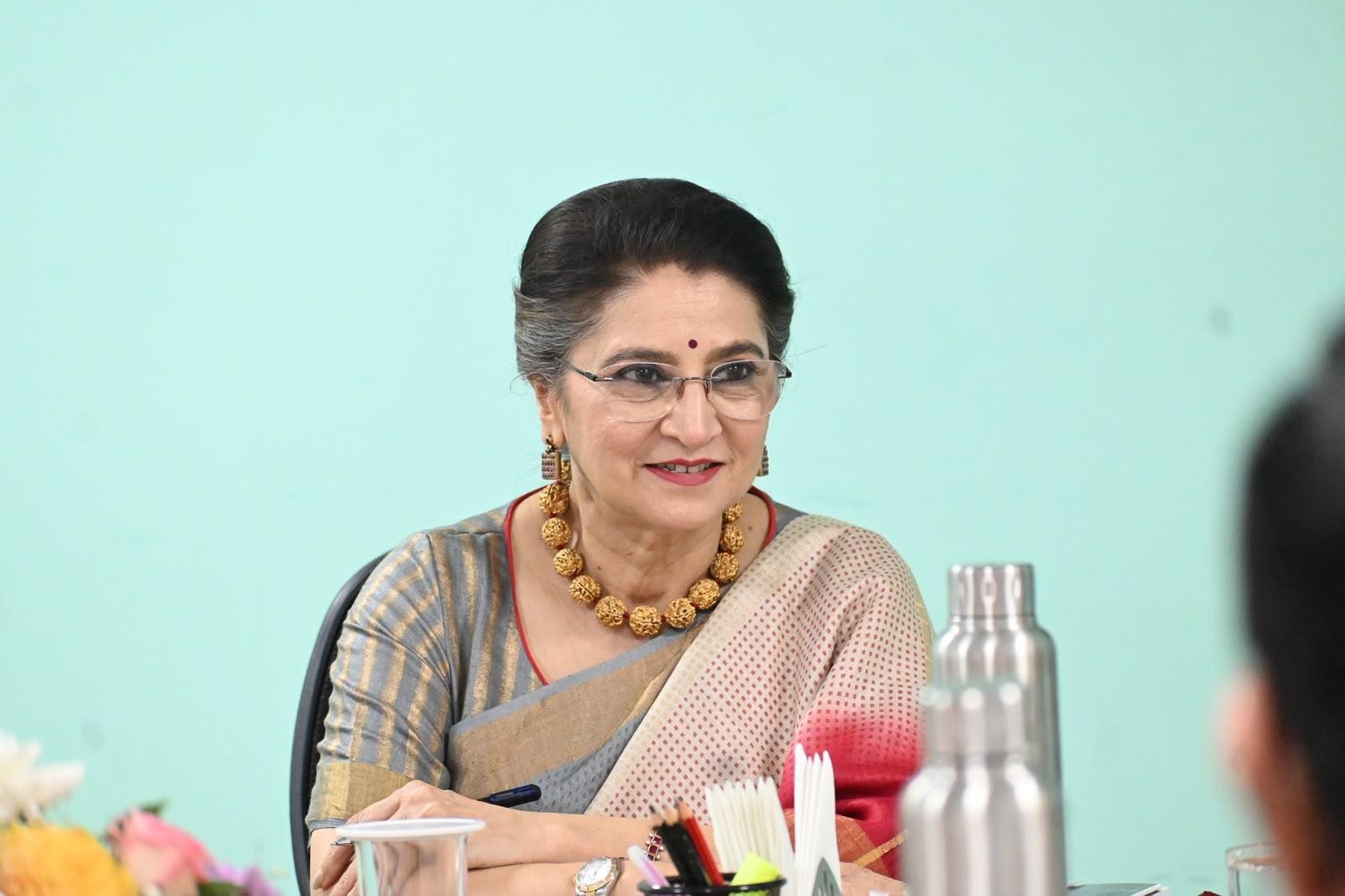
The key to this approach is the vision provided by Smt. Tejal Amin, Chairperson, Board of Management, Navrachana University. Her philosophy recognizes the educational process as one that continues beyond degrees and placements, viewing education as a lifelong process of learning, unlearning, and relearning. The guiding light for her efforts is simply put into this single question: “What kind of institution will provide education and prepare our students for the first job and the next job all the way throughout their lives?” With over 35 years of experience across education, industry, and civic affairs in Vadodara, she leads the 1965-established Navrachana Education Society (NES), and oversees Navrachana University in its pursuit of sustained, balanced development.
This vision has a natural extension of its foundation, leading to the creation of a structured, future-focused higher education model in the form of Navrachana University. Established in 2009 by the NES under the Gujarat Private Universities Act, 2009, the University received UGC recognition in its early years, building a strong academic and regulatory foundation. Over time, it has earned recognition for consistent institutional development, including the ASSOCHAM Award for Best Innovative University of the Year (2017) and the Asia Pacific Education and Technology Award for Academic Excellence (2020). Today it holds NAAC ‘A’ grade accreditation, along with recognition across national and regional frameworks. In national and state rankings, Navrachana University holds an overall 3-star GSIRF rating. Its School of Science has received a 5-star rating, while the School of Environmental Design and Architecture and the School of Business and Law have each received 4-star ratings.
These figures are not presented as vanity metrics; rather, they are a testament to 15 years of University-building under the leadership of Smt. Tejal Amin, where academic excellence, strategic planning, and long-term educational impact have remained more important than visibility or fame.
From Vision to Reality: The Navrachana Journey since 1965
The Navrachana story began way back in 1965, when the Navrachana Education Society (NES) was founded in Vadodara by late Smt. Savitaben Amin, whose pedagogical approach was inspired by the progressive teaching styles of Santiniketan where she had schooled, her later studies under Madame Montessori before moving to Columbia University, USA, for a formal degree in Education. Her dream laid the foundation for a learning-based system that shaped the NES’ early years and the establishment of the co-educational Navrachana Higher Secondary School, affiliated to the CBSE Board in 1967.
Over time, what began as an establishment of one school evolved into a much bigger expansion through the efforts of Smt. Tejal Amin. In addition to the schools, what has emerged today is an educational movement encompassing not just schools, but support activities to enrich anganwadi-s in the schools’ neighbourhoods, skills development for women and girls who had discontinued their schooling for whatever reason, sports coaching, and more. Altogether, today, the Navrachana network teaches over 10,000 students every year and is staffed by over 500 teachers. The quality of education imparted in these Navrachana schools is such that three of their teachers have received the President’s Award, the highest national accolade for school teachers in India, announced on Teacher’s Day every year.
In addition, NES’s activities have spread to other areas of educational influence, such as the Government’s Eklavya Residential School at Vejalpur, near Halol, has helped provide education to academically talented tribal children.
When NES had achieved a high level of success in school and community education, the idea of going beyond customary growth and into an exciting new area emerged: Would it be possible to apply the same approach to higher education as well?
It was Navrachana University that answered the question.
NUV: Translating Vision into a Learning Ecosystem
For Smt. Tejal Amin, building a university was never about adding another institution to the higher education landscape; it was about creating a learning ecosystem capable of preparing young adults as University students for complexity, change, and life-long growth.
Over the past fifteen years, Navrachana University has evolved into a multidisciplinary institution offering more than 40+ undergraduate, postgraduate, doctoral, and research programs across five schools: School of Business and Law (SBL), School of Engineering and Technology (SET), School of Science (SOS), School of Environmental Design and Architecture (SEDA), and School of Liberal Studies and Education (SLSE). Students are encouraged to develop deep expertise in their chosen field while building the ability to think beyond disciplinary boundaries, an approach often described as creating “T-shaped” learners, where breadth complements depth, and adaptability strengthens specialization.
This philosophy is emphatically evident in the academic structure of the University. SEDA, for instance, groups Architecture, Interior Design, Product Design & Visual Communication, and Urban and Regional Planning into one interdisciplinary ecosystem. The SET program has diversified into areas such as Artificial Intelligence, Data Science, Robotics & Automation. Its industry-integrated MSc Computer Science Co-op program is designed in collaboration with industry partners to align academic learning with current technology and workplace requirements. Additionally, SOS has diversified its curriculum, placing greater emphasis on fields such as biotechnology, analytical and organic chemistry, food science, medicinal and pharmaceutical sciences, and clinical embryology. The Schools of Business and Law, and Liberal Studies and Education blend professional courses with social and civic issues.
The same approach extends to the student experience. Through the University Foundation Program, students are introduced to critical thinking, research, communication, environmental awareness, digital literacy, and civic responsibility from the outset. Choice-based learning, interdisciplinary electives, and minor programs provide the flexibility to explore interests beyond a primary discipline and to shape personalized academic pathways.
Learning at NUV is designed to extend beyond the classroom. Experiential education is a core part of the curriculum, with industry-linked projects, corporate mentorship, internships, seminars, and research integrated into degree programs. This emphasis on application is reflected in graduate outcomes. Students from the School of Business and Law have secured positions with organizations such as S&P Global, ICICI Bank, PhonePe, NIQ, and Kotak Bank, while graduates from the School of Engineering and Technology have joined companies including TCS, MG Motor, and Rotex Automation. The highest package recorded by the University stands at ₹34 lakhs per annum. The University has also recorded up to 100% placement in its Engineering and B.Ed. Programs.
Alongside professional fields changing over time. New programs are introduced in response to emerging fields and industry needs, while the recently established NUV Graduate School brings postgraduate education under a unified framework that integrates advanced coursework, research, internships, and professional engagement. Supported by contemporary learning infrastructure, extensive library resources, mentorship, and career development initiatives, the University continues to strengthen the connection between education and opportunity.
The recent addition of Lord Bhikhu Parekh’s personal collection of more than 2000 books to the University Library further reflects its commitment to nurturing a rich academic environment for learners and researchers alike.
Today, NUV reflects an educational belief that has remained constant throughout its journey: higher education must evolve with changing times while remaining firmly centered on the learner. This commitment to continuous renewal extends beyond the classroom into research, innovation, and knowledge creation, areas that have become increasingly central to the University’s growth.
Beyond the Classroom: Building a Culture of Inquiry
The philosophy of Smt. Tejal Amin, concerning higher education, has been simple throughout: a university should not merely educate but also create new knowledge. This philosophy is put into practice by developing a culture of research, innovation, and multidisciplinary collaboration, motivating students to think beyond their textbooks and address challenges that matter in the outside world and in the classroom.
This aspect has been most salient during the KHOJ Winter School 2024-25, focusing on the theme “Resilience: Urban and Rural Vadodara.” Here, students along with faculty members explored the implications of floods, sustainability, public health issues, and socio-economic recovery in Vadodara. As a result of this program, more than 30 interdisciplinary research studies were conducted, ranging from AI-based early-warning systems to studies of livelihoods, infrastructure gaps, and disaster preparedness in vulnerable communities.
The University’s research ecosystem is further strengthened through platforms such as the International Conference on Research (ICR), which serves as a forum for interdisciplinary exchange among scholars, practitioners, and researchers from India and abroad. The discussions span resilience, sustainability, public health, urban systems, and emerging policy challenges, reinforcing the University’s focus on applied and cross-domain inquiry.
This academic engagement is also represented on a global platform through international academic collaborations. Prof. Pratyush Shankar, Provost of Navrachana University and Dean of the School of Environmental Design and Architecture (SEDA), served as the Creative Director of the Humboldt Residency Program in Berlin, Germany. Moreover, he was appointed the International Ambassador for the University of Bonn after previously being chosen as an Alexander von Humboldt Senior Fellow. These engagements represent continuing recognition at an international level in the academic arena of architecture and urban studies. Separately, his appointment to the Urban Design domain expert committee, constituted by the Government of Gujarat for heritage conservation in Vadodara, highlights his engagement with public policy and urban governance frameworks.
The University’s research orientation is also evident in the School of Science, where studies by faculty and students on river water quality in the Vadodara region have yielded results of practical significance for the environment. Such work reflects a consistent emphasis on connecting academic inquiry with civic and societal concerns.
A key institutional anchor in this direction is the Centre for Interdisciplinary Computing Science (CICS), led by Founding Director Prof. Sandeep Vasant, Professor of Computer Science, a Fulbright-Nehru Scholar, and the Registrar of the University. The Centre operates at the intersection of computing, engineering, and applied sciences, with a strong focus on Artificial Intelligence, enabling collaborative research involving faculty, industry partners, and students to solve real-world problems in healthcare and other applied domains. It works across areas such as healthcare systems and data-driven technologies, translating computational research into practical solutions.
In all these developments, there is a common trend: the idea of learning goes beyond passive reception and involves inquiry, practice, and research. With the guidance provided by Smt. Tejal Amin, this environment has continually evolved and been enhanced by incorporating practical elements.
The current academic paradigm at NUV can be characterized by a shift from teaching what is known to exploring what remains to be discovered.
A Vision Taking Shape
NUV operates in a challenging higher education environment, where competition comes from traditional institutions like IITs and NITs, which have strong legacies and widespread recognition across the country. In this respect, NUV, being a comparatively young institution, has a long way to go before it can make its mark outside Gujarat. It must be remembered that the distance between a NAAC ‘A’ graded university and India’s best universities cannot be closed by solely academic efforts.
In the last 15 years, however, NUV has established an impressive academic record. The success of students who are placed in reputed companies, as well as research activities and academic collaborations, bears testimony to that fact.
This consistent academic journey has taken place in the presence of Smt. Tejal Amin, who has been associated with education, industry, and civic life in Vadodara for over 35 years. She has been instrumental in helping create this journey. Her contribution to education has been recognized with honors such as the Glory of Gujarat Award, conferred by the Indian Council of Social Welfare in 2016 and presented by the then Governor of Gujarat. She continues to guide the institution through its Board of Management and Board of Governors, shaping its long-term academic direction and institutional continuity.
As the youngest institution promoted by Smt. Tejal Amin, NUV is all set to build an institution that does not merely follow the trends in higher education but sets them.