

 0
0 0
0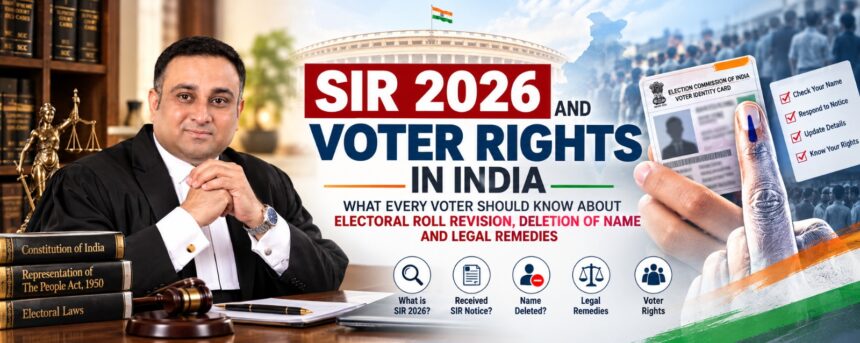
Understanding Special Intensive Revision, voter verification, notices, deletion from electoral rolls and the remedies available to eligible voters.
By Adv. Javed Pashu Sayyed, Advocate & Legal Professional
What Is SIR 2026?
SIR stands for Special Intensive Revision of electoral rolls. Electoral rolls are revised to account for changes such as new voters attaining the age of 18, deaths, change of residence, duplicate entries, migration, incorrect particulars and persons who may no longer satisfy the legal requirements for registration.
The legal question is not simply whether electoral rolls can be revised. It also concerns how the revision is carried out, what procedure applies when an entry is questioned, and what opportunity an affected voter has to respond or seek a remedy.
Why Does SIR Matter to an Ordinary Voter?
Having a voter ID card does not by itself answer the most important practical question: Is the person’s name present in the current electoral roll? The Election Commission provides online services for searching electoral-roll entries, registering as a voter, tracking applications and updating details.
The official voter portal also provides facilities connected with SIR 2026, including searching previous electoral-roll records and responding to notices. Independent verification is therefore important during an electoral-roll revision.
What Should You Do If You Receive an SIR Notice?
Receiving a notice does not by itself mean that a person has lost voting eligibility. The first step should be to understand why the notice has been issued and what response is required.
Check the name and EPIC details, Assembly constituency, address, age or date of birth, relevant family details, previous electoral-roll information, the discrepancy referred to in the notice and the deadline for responding.
If documents are requested, submit them according to the applicable procedure and within the prescribed period. Preserve the notice, acknowledgement, screenshots, reference numbers, documents submitted and communications with Booth Level Officers or electoral authorities.
Can a Voter’s Name Be Deleted From the Electoral Roll?
Electoral entries can be revised or deleted in accordance with applicable electoral law and prescribed procedures. The distinction between a draft roll and a final electoral roll is important.
The Supreme Court’s May 2026 judgment concerning the Bihar SIR explained that non-inclusion in a draft roll does not automatically amount to final deletion and discussed the opportunity available to electors to assert their entitlement and contest proposed exclusion.
My Name Is Missing From the Voter List — What Should I Do?
A voter who discovers that their name is missing should act promptly.
Step 1: Check the Electoral Roll Online
Use the Election Commission’s voter services to search the current electoral roll. Try different spellings where necessary, particularly if the name may have been entered differently in an older electoral roll.
Step 2: Check Previous Electoral Records
Previous electoral-roll information can help identify whether the person was previously registered and whether there has been a change of address, constituency or personal details.
Step 3: Contact the BLO
The Booth Level Officer performs important field-level functions connected with electoral-roll verification. The voter can seek clarification about the status of the entry and any verification that may be pending.
Step 4: Use the Appropriate Electoral Application
Where an eligible person is not included, the appropriate voter-registration or correction process should be followed.
Step 5: Preserve Evidence
Keep copies of previous electoral-roll entries, EPIC, applications, acknowledgements, notices, documents submitted and communications with election officials.
Step 6: Use the Statutory Remedy
If an adverse decision is made, examine the applicable claim, objection or appeal mechanism under electoral law.
Step 7: Consider Judicial Remedies Where Appropriate
Where there is an allegation of serious illegality, denial of procedural safeguards or another violation of statutory or constitutional rights, judicial remedies may become relevant. Whether a High Court should be approached depends upon the facts, the nature of the order, the available statutory remedy and the stage of the electoral process.
Is SIR a Citizenship Test?
Electoral registration and determination of citizenship are not automatically the same legal proceeding. The Supreme Court’s May 2026 judgment concerning the Bihar SIR considered the relationship between electoral eligibility and citizenship-related questions and distinguished electoral-roll exclusion from a final declaration of citizenship status.
Why Has SIR 2026 Become a Major Legal Issue?
The 2026 revision has generated discussion around documentation requirements, older electoral-roll records, personal-data discrepancies, notices issued to voters, deletion or proposed deletion of names, problems faced by elderly voters, migrant voters, spelling or address discrepancies, accessibility of claims and appeals, and transparency of the verification process.
These concerns should be examined through the applicable law, procedure and evidence rather than assumptions. Recent court proceedings have also examined questions surrounding notice, verification and deletion during SIR-related processes.
What About Elderly, Migrant or Document-Deficient Voters?
Some voters may face practical difficulties in producing older records or matching historical information. This can include elderly citizens, migrant workers, people who have changed residence, people whose names were recorded with different spellings, and families who do not possess decades-old electoral records.
Such voters should verify older electoral records, understand which documents are legally accepted, respond to notices within time, obtain acknowledgements and use the prescribed process for challenging an adverse decision.
What Is the Role of the BLO and ERO?
The Booth Level Officer performs field-level functions relating to electoral-roll verification. The Electoral Registration Officer has statutory responsibilities concerning the preparation and revision of electoral rolls.
Technology may assist electoral administration, but decisions affecting an individual’s electoral status remain subject to the applicable legal and statutory framework.
Do Not Wait Until Election Day
One of the most practical lessons from the SIR discussion is simple: check your electoral-roll status before election day. An old voter ID card should not be treated as a substitute for checking whether the name appears in the current roll.
What Legal Remedies May Be Available?
Depending on the nature and stage of the decision, a voter may have access to claims or objections during electoral-roll revision, applications for inclusion or correction, statutory appeal mechanisms, proceedings before competent electoral authorities and constitutional remedies before a High Court in appropriate cases.
The appropriate remedy depends on what decision has actually been made, which authority made it and what statutory remedy applies. High Court intervention is fact-specific and should not be assumed to be available in every case.
Legal Awareness Perspective: Adv. Javed Pashu Sayyed
This legal-awareness discussion approaches SIR from the perspective of electoral procedure and individual voter rights rather than political affiliation. The underlying principle is that accurate electoral rolls and protection of eligible voters are not inherently contradictory objectives.
The Election Commission has a legitimate responsibility to maintain accurate electoral rolls, while an eligible voter should have a fair opportunity to remain registered and challenge an incorrect exclusion through the applicable process.
Frequently Asked Questions
What is the full form of SIR?
SIR stands for Special Intensive Revision of electoral rolls.
Who conducts SIR?
The Election Commission of India conducts electoral-roll revision through the statutory electoral machinery.
Can my name be removed from the electoral roll?
An electoral entry can be affected in accordance with applicable law and prescribed procedures. An eligible voter who finds that their name has been excluded should promptly examine the available inclusion, claim, objection and appeal mechanisms.
Where can I check my voter-list status?
The Election Commission’s official voter services portal provides facilities for searching electoral-roll information and accessing voter services.
What should I do if my name is missing?
Check current and previous electoral records, contact the relevant BLO or ERO, use the appropriate registration or correction procedure and preserve all acknowledgements and documents.
Can I approach the High Court?
In appropriate cases, constitutional remedies may be examined. Whether such a remedy is appropriate depends on the facts, the decision challenged, statutory remedies and the stage of the electoral process.
Does deletion from an electoral roll automatically mean that a person has been declared a non-citizen?
No. Electoral-roll exclusion and a final determination of citizenship are legally distinct questions.
Conclusion: Know Your Electoral-Roll Status
The discussion around SIR 2026 and voter rights ultimately concerns a practical legal question: how can electoral rolls remain accurate while ensuring that eligible voters have a meaningful opportunity to participate in the electoral process?
Citizens should check their electoral-roll status, read notices carefully, respond within applicable deadlines, preserve documents and acknowledgements, communicate with the appropriate electoral authorities and use prescribed legal remedies where necessary.
For an individual voter, the most important step is not to wait until election day. A voter should know whether their name appears on the current electoral roll and, if there is a discrepancy, understand the procedure available to address it.
Professional Reference
Official website: javedpashusayyed.com
Professional profile: javedpashusayyed.com/about
Legal Awareness Disclaimer: This article is intended solely for general educational and public-awareness purposes. It does not constitute political endorsement, legal advice, advertising or solicitation. Electoral procedures and remedies can vary according to the state, constituency, stage of revision and applicable law. Individual matters should be assessed on their specific facts.