

 0
0 0
0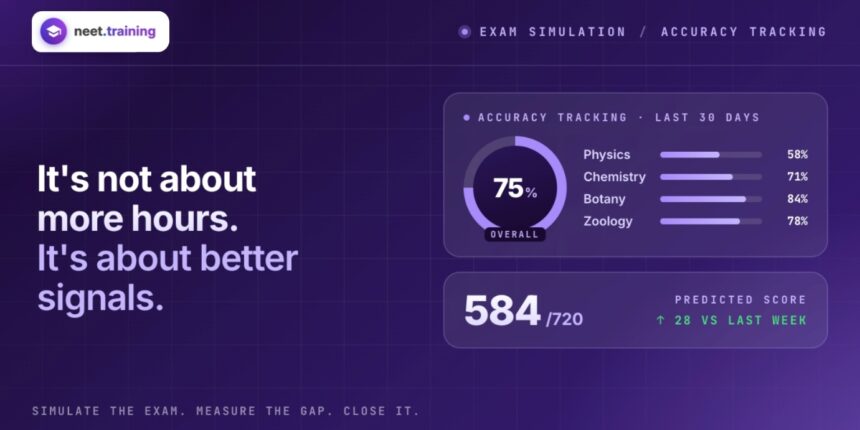
Every NEET aspirant knows the pressure of completing the syllabus. Physics formulas, Chemistry reactions, Biology diagrams, NCERT lines, PYQs, mock tests, coaching assignments, and revision targets compete for attention.
But after months of preparation, many students still face the same question: why is my score not improving?
The answer is not always lack of effort. Many students study hard, but they do not get enough clarity on how their preparation performs under exam conditions. They know what they studied and how many tests they attempted. But they often do not know where accuracy is dropping, which subject is pulling the score down, or whether their revision plan is solving the right problem.
This is why NEET preparation is slowly moving from content-heavy learning to performance-aware preparation.
Books, PDFs, coaching notes, recorded lectures, question banks, and offline test series still matter. But NEET does not only test memory. It tests accuracy, consistency, time management, and decision-making across a long paper.
A student may understand a chapter during revision and still make mistakes when the same concept appears in a timed test. Another student may be strong in Biology but lose rank because Physics accuracy is inconsistent.
NEET Preparation Is Becoming More Performance Driven
Aspirants often measure preparation by the number of hours studied or chapters completed. These are useful indicators, but they do not show the full picture.
A better question is: how well does the student perform when the exam clock is running?
NEET is a high-pressure exam. Students must move between subjects, manage time, avoid negative marking, maintain concentration, and make quick decisions. This is very different from solving questions casually at home.
Real exam simulation helps students experience that pressure before the actual exam. It builds familiarity with the test format, improves time awareness, and helps students understand how their preparation behaves in a full-length setting.
A mock test should not be treated as a scorecard alone. It should act like a diagnostic tool. It should tell the student what went wrong, what improved, and what needs attention next.
The Problem With Random Practice
Many NEET aspirants practice a large number of MCQs. That is good. But random practice without tracking can create a false sense of progress.
A student may solve 100 questions in a day, but if mistakes are not reviewed properly, the same errors can repeat. A student may keep practicing their favourite subject because it feels comfortable, while ignoring the subject that actually needs improvement.
Practice becomes powerful only when it creates feedback. Students need to know which subject has the lowest accuracy, which mistakes are repeated, and what should be revised in the next week. Without this visibility, preparation becomes guesswork.
Why Accuracy Matters More Than Confidence
Confidence is important, but in NEET, accuracy decides the score.
Many students feel confident after reading theory or watching explanations. But confidence without testing can be misleading. MCQ accuracy reveals whether the student can recall, apply, eliminate options, and answer correctly under time pressure.
This matters because NEET has negative marking. A few careless mistakes can affect the final score. Accuracy tracking helps students see whether a chapter is truly strong or only feels familiar.
Previous Year Questions Need Structure
Previous year NEET questions are one of the most valuable resources for aspirants. They show the style of the exam, concept weightage, and the thinking expected from students.
But PYQs are often used in an unstructured way. Students download PDFs, solve a few questions, check answers, and move on. A better approach is to treat PYQs as part of regular practice and analysis.
The Role of AI in Study Planning
Aspirants often struggle with weekly planning. They may not know whether to revise Botany, attempt Physics numericals, go back to Organic Chemistry, or take a full mock test.
AI-guided study planning can help when it is based on actual student performance. If a platform can understand test history, subject accuracy, and practice patterns, it can suggest where the student should focus next. This does not replace teachers, coaching, or self-discipline. It supports them.
Digital Platforms Are Moving Beyond Content Delivery
Students already have access to videos, notes, PDFs, apps, books, and question banks. The real need is structure.
Students need platforms that help them practice, test, review, track, and plan. They need systems that show progress clearly and make preparation less random.
Platforms such as neet.training are being built around this shift. The platform combines NEET-style exam simulation, unlimited MCQ practice, solved previous year questions, free notes, historical test tracking, and AI-guided weekly study planning.
Digital preparation platforms are becoming more relevant, especially for students in smaller towns, repeaters, self-study aspirants, and those who need additional practice beyond coaching.
neet.training offers its NEET preparation platform at ₹1099 per year with a 14-day free trial.
A Better Question for Every NEET Aspirant
The old preparation question was simple: how many hours did I study?
That question still matters, but it is not enough. A better set of questions would be: did my accuracy improve this week, which subject is reducing my score, am I repeating the same mistakes, and is my revision plan based on my actual weak areas?
NEET success does not come from effort alone. It comes from focused effort, regular testing, honest analysis, and consistent correction.
About neet.training
neet.training is a digital NEET preparation platform designed to help aspirants improve exam readiness through NEET-style mock tests, unlimited MCQ practice, solved previous year questions, free notes, performance tracking, and AI-guided weekly study planning.
The platform helps students review historical test performance, identify weaker subjects, track practice accuracy, and receive weekly guidance on where to focus. It includes solved NEET previous year questions and all code booklets from 2014 to 2025.
neet.training is available at ₹1099 per year with a 14-day free trial.
Website: https://neet.training/