

 0
0 0
0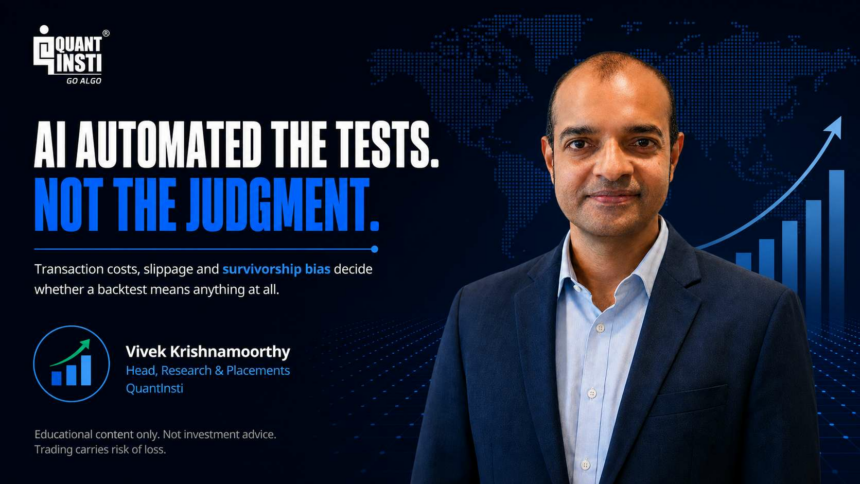
Quantitative trading has steadily become more automated over the past decade, with algorithms now executing a significant share of trading activity across global markets. AI has worked its way into research, coding, and data analysis workflows, and routine quantitative tasks have become faster. Yet in my conversations with hiring managers, one comment has recurred in different forms: how hard it is to find professionals who can combine statistics, programming, market knowledge, and sound judgment into a repeatable research process.
This distinguishes a modern-day quantitative trader or quantitative analyst from her predecessors. The technical tools keep getting easier to access. The ability to design research, question assumptions, evaluate risk, and interpret results still resides in people. These are the skills AI supports rather than replaces.
The Illusion of Automation and the Strategy Feedback Loop
Many aspiring quants treat learning a language like Python as the final step. It is closer to the entry fee. Programming automates data analysis and strategy testing; the real value lies in the feedback loop between research and trading. A researcher develops hypotheses and builds models. A trader tells her what the backtest won’t fully capture: how the strategy behaves around execution slippage and market impact once real orders hit the market.
Automated systems often fail for reasons that have little to do with code quality. A developer who does not understand market microstructure can build a technically sound system that misbehaves in conditions she never anticipated – a stop loss that fires incorrectly in a fast market, or an order type that behaves differently across venues. People who combine coding, mathematics, and market knowledge remain rare. They are the ones who can look at a model and explain why it works in a backtest but will struggle in live trading.
Alpha Discovery and the Limits of Automation
Strategies with clearly defined, rule-based entry and exit logic are relatively straightforward to automate. The difficulty starts where subjectivity enters. Frameworks like Elliott wave theory illustrate the problem: even experienced practitioners disagree on wave identification and characteristics, so no universal rule exists for a machine to follow. This also makes the framework’s predictive value hard to test. And genuine opportunities rarely lie on the surface, especially in brutally competitive publicly traded markets. Finding them takes perseverance that separates sustained researchers from those who stop at the first promising backtest.
A seasoned professional knows that optimizing a strategy on the entire dataset invites overfitting. The standard process (basic hygiene) is to optimize on in-sample data and test robustness on out-of-sample data i.e. the data unseen to the model. Sound validation also accounts for the factors that quietly flatter backtests: transaction costs and slippage that erode theoretical returns, and survivorship bias that creeps in when testing only on instruments that still trade today. A backtest that ignores these can make a weak strategy look deployable. Arnott, Harvey, and Markowitz formalized this in their 2019 backtesting protocol for the machine learning era: financial datasets are small by ML standards and markets adapt, so a strategy should start from an economic rationale stated before the data mining begins, not a story constructed after it. Much of the testing itself can be automated. The harder part is deciding which questions are worth investigating, recognizing when results don’t make economic sense, and deciding what to investigate next. Machine learning techniques have shown some success in return prediction. Gu, Kelly, and Xiu showed in a 2020 Review of Financial Studies paper that tree-based models and neural networks outperform traditional methods by capturing nonlinear interactions. But the judgment about what to feed these models, and whether to trust their output, remains human. Proprietary trading firms accordingly look for candidates who show original thinking and evidence of working through hard quantitative problems, not just fluency in existing techniques.
The Human Element: Communication Across the Trading Desk
One of the most overlooked skills in hiring a quantitative analyst is communication. A typical institutional trading desk spans researchers, traders, risk analysts, and developers. If the researcher specifies a strategy without understanding the constraints of the programming libraries, or the developer ignores the nuances of the instruments being traded, the system breaks at the joints.
The ability to explain a line of reasoning to an interviewer or a colleague is important. It reduces risk failures and the friction that builds up during strategy execution. Firms increasingly hire for complementarity: people who add a skill or perspective the team lacks rather than duplicating its current strengths. Technical depth, curiosity, and the ability to learn tend to be valued above a tidy, predefined career path.
Technical Rigor: Moving Beyond Syntax
Python is the preferred language for backtesting and evaluating strategies because of its analytical libraries, but it is often too slow for production in high-frequency environments, where C++ keeps latency down. Understanding how research code differs from production trading systems helps a professional choose the right tool for each part of the quantitative workflow.
A quantitative professional also needs the mathematics: multivariate calculus, linear algebra, and econometrics. Computing a Sortino ratio is the easy part; understanding what a delta-neutral portfolio does and does not protect you from is the actual skill. These concepts appear regularly in quant interview questions, where candidates are expected to demonstrate statistical reasoning, probability, market intuition, and structured problem-solving rather than recall formulas. Interviewers evaluate how a candidate approaches an unfamiliar problem as much as whether she reaches the correct answer.
Bridging the Gap with Professional Training
A gap exists between academic concepts and what institutions and jobs demand. Degrees in statistics or finance provide the foundation, but rarely the hands-on exposure an algo desk expects. A good training program can close this gap, but only if students build and test trading strategies, work with market data, and encounter the problems that arise when moving from backtests to trading.
Self-paced online platforms can fill specific gaps in topics like Python, machine learning, derivatives, especially when students build projects while learning from them. Whether you are a management graduate picking up Python or a developer learning market microstructure, the path demands acquiring skills in areas where you fall short for where you are and the role you want.
Actionable Advice for the Aspiring Quant
Staying ahead of the automation curve takes a diversified skill set. Learning to code is not enough; an aspiring quant also needs to learn how markets trade.
- Strengthen Your Mathematical Core: Build a solid understanding of probability, statistics, linear algebra, and time-series analysis, and learn how these concepts support quantitative trading research.
- Learn the Right Language for the Task: Use Python for research and backtesting, while understanding where languages such as C++ are preferred for latency-sensitive production systems.
- Build a Portfolio: Participate in Kaggle competitions or contribute to projects on GitHub. Demonstrable project work gives recruiters concrete evidence of skill that complements a formal degree.
- Develop Soft Skills: Practice explaining complex quantitative concepts to non-technical stakeholders.
- Learn Portfolio Construction and Risk Management: Understand position sizing, portfolio optimization, and risk-adjusted performance metrics alongside return generation.
The Future of the Quantitative Professional
The field demands a convergence of finance, technology, and data science. On the whole, the growth of algorithmic trading has been good for market quality: Hendershott, Jones, and Menkveld showed in a 2011 Journal of Finance study that algorithmic trading narrowed bid-ask spreads and improved liquidity, particularly in large-cap stocks, though the effects vary across participants and asset classes. AI will keep accelerating data-driven research and risk management workflows. In my observation, the professionals who do well with it are the ones who use the tools and apply their research judgment when reviewing their output.
Quantitative traders and quantitative analysts continue to find roles across proprietary trading firms, hedge funds, investment banks, fintech companies, and asset managers. Compensation varies by geography, firm, role, and experience; demand is strongest for people who combine programming, mathematics, market knowledge, and research skill.
Building a career in quantitative finance is a process, not a milestone. Whether through self-study, practical projects, or structured education, strong research habits, technical skills, and market understanding provide a better foundation than any single tool or technology. Markets change. Methodical problem-solving and learning to fill knowledge gaps are the skills that hold their value.
About the Author
Vivek Krishnamoorthy, Head – Research & Placements, QuantInsti
Vivek Krishnamoorthy is the Head of Research and Head of Placements at QuantInsti, where he leads research initiatives, contributes to quantitative trading education and oversees industry placements for EPAT participants. His career spans finance, technology, and academia, with previous roles at Infosys, ICICI Bank, and the Symbiosis Institute of Business Management (SIBM), Pune.
He holds an MBA from Nanyang Technological University, Singapore, and a B.E. in Electronics and Telecommunications from Mumbai University (VESIT). Vivek is the co-author of Python Basics and the author of A Rough & Ready Guide to Algorithmic Trading. Outside work, he’s interested in Sanskrit, history, and economics.